What it looks like
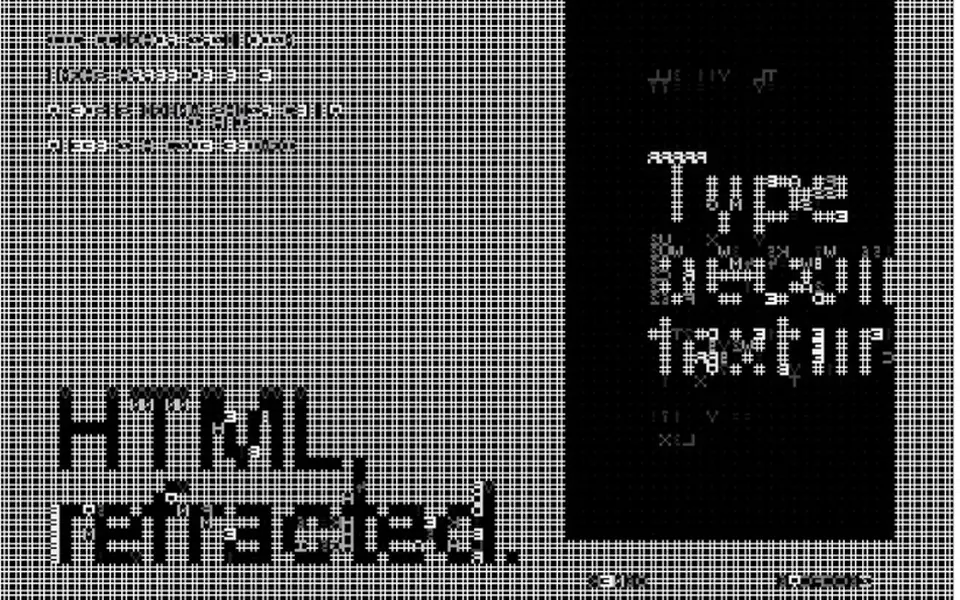
It looks like an old terminal drawing your page with letters. The block is split into a grid of 8-pixel cells, and each cell gets a character made of 5 by 5 dots: bright areas become full characters, dark areas become faint dots, and each character keeps the original color of that spot. The result is a text mosaic on a dark background that follows changes in the content. Pressing the surface with the mouse or a finger turns the characters monochrome. Cell size is adjustable, starting at 5 pixels.
You may be looking for this if you asked for something like
- turn my page into little letters like ASCII art
- a hacker terminal effect over my website
- text and images that turn into characters like in a hacker movie
- a retro old computer look applied to HTML
- a demo page drawn only with keyboard symbols
- a tech event landing page that looks like a code screen
Also known as
- ASCII art effect
- ASCII shader
- live HTML shader
- terminal effect
- character art
- glyph rendering
When to use
- Prototypes and concept demos with a hacker or retro look
- Tech event, hackathon or game jam pages
- Portfolio experiments that show shader skills
When to avoid
- Client production work: it relies on an experimental browser API, as the prompt itself warns
- Reading areas, since the text turns into texture and loses legibility
- Devices without WebGL2, where the effect simply does not appear
How to ask your AI
Build a prototype with a WebGL2 ASCII art effect over a live HTML block, keeping links clickable and accessible, pausing off screen, with a static version for reduced motion and plain HTML as the fallback without support.
With THM Componentes, you paste the full prompt from the catalog together with this component's code, and the AI reproduces this exact effect instead of improvising.
Questions about Ponto-cruz
Can I use Ponto-cruz in production?
It is not recommended. Ponto-cruz uses a still experimental browser API to draw HTML inside a canvas and, when it is missing, falls back to a capture of the content. The THM Componentes prompt is direct about it: use it only in prototypes, never in client production.
Do links inside Ponto-cruz stay clickable?
They do. Ponto-cruz keeps the original content on the page for interaction and screen readers, and the canvas with the characters sits on top without catching clicks. Only pressing on the surface has its own visual effect: the characters turn monochrome while the button or finger is held down.
Does Ponto-cruz need another component?
Yes. Ponto-cruz is an effect built on the base Crisol component, which handles the HTML capture, WebGL2 and the automatic fallback. The effect file imports that shared renderer, so both need to be in your project. The same goes for the other HTML effects in the catalog.